Tuesday, April 2, 2019
Saturday, November 12, 2011
I'm mostly posting on Google Plus now
I've moved almost all of my blogging-like activity over to Google Plus.
My profile on Google Plus has some amount of public content, and if you follow me there and I know you, I'll add you and I share quite a bit more to my limited circles. My public posts on my profile are a bit skewed toward photography.
For board gaming related posts, I've also created a "Plus Page": mkgray Board Games where I'm posting most of my public board gaming related comments. I just started it earlier this week, but have a big burst of activity due to a ton of gaming at Lobster Trap (a friend's mini-gaming con).
Saturday, January 8, 2011
2010 Gaming
My "game of the year" is pretty definitely Space Alert, which for me is a perfect combination of programmed action, cooperation & realtime play, the former two of which I like a lot, and the last which I like when well done, and it's well done in Space Alert.
Dominion remained popular and will likely continue to do so, though RftG somehow almost entirely slipped out of play this year, which is a little sad. I'll have to make sure to go back to it more in 2011. Non-kids games successfully played with the kids this year: Dominion, It's Mine, Ciao Ciao, & Rumis, notably.
- 302 Games Played
- 52% at home (family & guests)
- 9% at work
- 18% regular gaming group
- 175 different Titles
- 105 days with at least one game played
- 51 new-to-me games played
- Gamed with 126 different people
- 32 new games or expansions acquired
- 32 games of Dominion (9 with 6-yo!)
- 17 games of Space Alert
- 6 games of Forbidden Island
- 6 games of Nacht der Magier
- 5 games of It's Mine!
- 5 games of Ciao Ciao
- 5 games of Zigzag
- 5 games of Zick Zack Huhnerkake
Saturday, August 14, 2010
Clue Treasure Hunts for kids
This past winter, at the suggestion of David Saff, I started creating "treasure hunts" for my kids, partially as an activity to enhance reading vocabulary, but mostly for fun. The hunts take the form of a bunch of index cards on which I write a clue, like so:
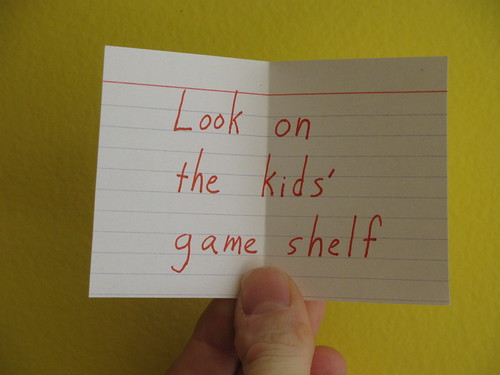
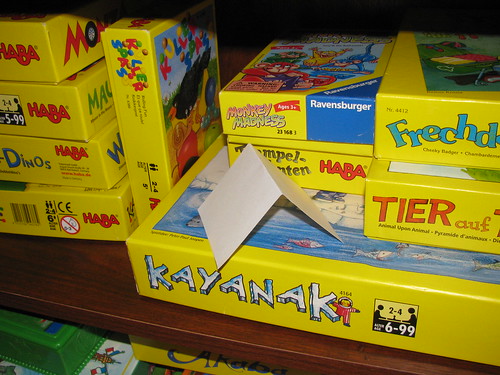
Finally, at the end of the hunt they find a "treasure", which for us is just a poker chip which they then put in their treasure bag which acts as a log of all the hunts they've done. A white poker chip is at the end of a short 5-clue hunt, a red at the end of a 8-clue hunt, a blue at the end of a 12-clue hunt and a gold chip at the end of a 18-clue hunt. At this point I've got a stack of 50+ clues which are more or less complete composable into new hunts, meaning that it's easy to set-up a new hunt by hiding clues relatively quickly and soon the kids are off to the races. These treasure hunts have been a rousing success, with some of the clues getting a star on them, indicating they are suitable for reading by my son, who's not quite reading age yet. I highly recommend these hunts to any parent with children around age 5 or 6.
As they got better at the basic hunts, I added more complex clues, including fill-in-the-blank clues and dictionary clues. The fill-in-the-blank clues look like this:

So, under the couch they might find the word "behind" and on the red chair they might find the phrase "the TV", and the next instruction would be found behind the TV. For dictionary clues, they would be given a dictionary of nonsense words at the beginning of the hunt and the clue would be of the form "Look flurb the siddy boff." and they'd have to decode the clue with the dictionary.
So, for Genevieve's 6th birthday party, I decided to have an elaborate multi-stage treasure hunt. The goal of the hunt was to rescue/find 4 fairies hidden around the yard. But, in order to find the fairies, you needed to follow clues on treasure hunts, like the ones I described. But, in order to get the first clue for each treasure hunt, the kids needed to "buy" the clue with treasures. In order to get the treasures, they had to go on "Quests" and complete "Challenges" which were essentially various little backyard birthday party games. A kid would complete a Quest and they'd get treasure, like "1 silver ring and 2 red hearts" and another would complete a Challenge and get "2 gold coins and a blue gem", etc. Then to buy the clues they'd have some large combination price like "1 blue gem, 5 gold coins, 1 silver ring, 5 red hearts", like so:

During the course of the individual fairy treasure hunts, some of the individual clues, rather than specifying a location, would say "Bring 1 gold coin, 1 blue gem and 1 silver ring to the Royal Court." (The Royal Court was the grownups) meaning they'd have to see if they had enough resources or they'd do more challenges/quests.
As the party approached and I explained the plan to family & friends, I got a lot of raised eyebrows expressing skepticism as to whether the whole thing was a bit complex for 6-year-olds. The party came and it was an outstanding success; the kids understood it without difficulty and had an absolute blast. I highly recommend it.
Friday, January 1, 2010
2009 Games Summary
I managed to hit the one-game-per-day threshold just barely this year. Gaming with the kids has continued to progress, and that's allowed us to start hosting more gaming. Hopefully, lots more in 2010. There's still lots of good gaming at lunch at work, though my personal amount of play has gone down a bit. Race and Dominion dominated again, and overall another good year of gaming.
My kids are great gamers. My 5-year-old now plays real games, and is beginning to learn some actual tactics, and my 3-year-old finally has enough patience for an extended (ie 20 minute) game. Non-kids' games successfully played with kids include: Quoridor, Twixt, Zig Zag, Chess, Pitch Car, Pingvinas, Blokus Trigon, Dvonn, and a variety of others, focused on abstracts.
Overall Stats
- 365 Games Played
- 44% at home (family & guests)
- 15% at work
- 22% regular gaming group
- 12% "events" (eg, Unity Games)
- 7% other friends' homes
- 192 different Titles
- 141 days with at least one game played
- 54 new-to-me games played
- Gamed with 162 different people
- 33 new games or expansions acquired
- 44 games of Race for the Galaxy
- 43 games of Dominion
- 9 games of Electronic Catchphrase
- 8 games of Connect Four
- 7 games of Viva Topo!
- 6 games of Loopin' Louie
- 5 games of Quoridor
- 5 games of The Adventurers
- 5 games of Go Away Monster!
New Games
The kids' game success of the year was clearly Viva Topo! which I picked up at Danger Planet when they had their store closing clearance. It's a nice push your luck race game, which is a mechanic that works well with kids.
Among the adult games, only the expansions for Race and Dominion really stand out. Three Commandments, The Adventurers, Ghost Stories and At the Gates of Loyang were all very good, but none are breakout hits.
Ten Years of Games
I have been tracking the games I play now for 10 years. I tracked games some in '97, '98 and '99, but didn't start keeping really good records until 2000. In this past decade, I played:
- 4480 games: 1.2 games/day
- 1060 titles: 2 new titles/week
- 1267 different days: 2.4 days/week
- with 977 different people: 8 new people/month
Top People
Of the top ten people (by number of games played) my wife and daughter are #1 and #10. Of the remaining eight, two (FR & ET) are folks I game with every month, two are people I've gamed with many times a year for the entire decade (RS & SD) and four are four are people who I gamed with a lot and then they moved away.
Top Games
The following 30 games got 20 or more plays in the decade:
100+: Electronic Catchphrase, Race for the Galaxy, Crokinole
50+: Dominion, Call My Bluff, Speed
40+: Battle Line, 6 nimmt!, Geister, Spin Ball, Can't Stop
30+: For Sale, Zirkus Flohcati, Apples to Apples, Light Speed, Loopin' Louie, Trans America, Knockabout
20+: Pente, Ra, Carcassonne, Puerto Rico, Go Away Monster!, Blue Moon, Hick Hack in Gacklewack, Werewolf, Heroscape, Flinke Pinke, San Juan, Princes of Florence
A few games that didn't make the 20 plays threshold, but deserve mention from this decade, for me: Descent, Traumfabrik, Vinci, Fiese Freunde Fette Feten, RoboRally, Power Grid, Schnaeppchen Jagd, Goa, Battlestations, Medici, Fresh Fish & Medina.
Every Year
Only four games got played every year of the decade, because well, a lot of great games came out during the past decade. Those four are Igel Argern, Can't Stop, 6 nimmt! and Ra. A bunch of games managed to hit 9/10 years though: Medici, Knockabout, Crokinole, Basari, Battle Line, Call my Bluff, Lord of the Rings, For Sale, Zirkus Flohcati, Speed, Electronic Catchphrase & Apples to Apples.
Year-by-year breakdown
Year    Games   New     Diff    Ses     Ppl
1997     ~30
1998    ~100
1999    ~150     63
2000     301    112     141     126     129
2001     712    172     266     175     165
2002     650    161     279     163     241
2003     552    128     272     129     180
2004     470     80     212     112     216
2005     429     92     208     124     236
2006     365     84     205      83     216
2007     256     73     153      78     170
2008     370     66     168     140     159
2009 365 54 192 141 162Monday, September 14, 2009
People who are unintentional "spoilers"
I've noticed some interesting cross-player interactions in game win rates. If a player is good at a particular game, or games in general, you'd expect them their performance to be relatively consistent across opponents. Or, you might reasonably expect they do well against most opponents, but not against others, who beat them more often, even if that opponent isn't as good in general. That is, you might see a rock-paper-scissors kind of effect.
But, in at least two cases, I've observed a different phenomenon, where a particular player "S" has a substantial effect on the performance of player "P", without that performance coming at a cost or benefit in S's performance. Here's the two examples I've observed. All games include me as well, so it may be a three-way interaction.
I have a colleague T who we play a lot of Race for the Galaxy with. He is good at it. He has won 20 out of 46 plays, with an average number of players of 4. But, if you break it down further, there's another person "R" who basically is necessary for T's performance to be high:
T's win rate, games with R: 18/33
T's win rate, games without R: 2/13
Further, while R does better when T is not in the game, the effect on his own play is only part of the change in win rates:
R's win rate, games with T: 5/33
R's win rate, games without T: 6/16
In the other example, the effect seems to apply across all games. "E" does very well overall. In 327 games, he's won 94 games with an expected number of wins of 80, given the numbers of players. But, when A plays, E's performance suffers badly, but it doesn't really help A:
E's wins, without A: 87 wins, 69 expected (276 games)
E's wins, with A: 6 actual, 10 expected (51 games)
A's wins, without E: 22 wins, 23 expected (93 games)
A's wins, with E: 10 wins, 10 expected (51 games)
In both cases the help (R) or hindrance (A) seems mostly distribute wins to other players. Since I'm the only other constant player throughout the games:
My wins (E, not A): 65 (69 expected, over 283 games)
My wins (E & A): 17 (10 expected over 51 games)
My wins (T, not R): 6 (3 expected, 13 games)
My wins (T & R): 6 (8 expected, 33 games)
One more example, lest this all sound like sour grapes; the introduction of R or A helps or impedes the other players as well:
Games with T & !R: T wins 15%, neither I nor T wins 38%.
Games with T & R: T wins 55%, neither I nor T wins 27%.
So, R benefits T and impedes everyone else.
(Limiting to 4 player games with E & A so the percentages can be compared)
Games with E & !A: E wins 42%, neither I nor E win 40%
Games with E & A: E wins 0%, neither I nor E win 53%
So, A impedes E and benefits everyone else.
Further, I'm pretty confident in neither of these cases is the spoiler intentionally helping or hurting the other player. That is, R isn't trying to help T, and A isn't targeting E, it just happens that way.
There's lots of plausible mechanisms, psychological, in-game, and otherwise for what's going on here, for which I don't have any compelling data, but it's an interesting phenomenon, or perhaps simply an anomaly.
Neat.
But, in at least two cases, I've observed a different phenomenon, where a particular player "S" has a substantial effect on the performance of player "P", without that performance coming at a cost or benefit in S's performance. Here's the two examples I've observed. All games include me as well, so it may be a three-way interaction.
I have a colleague T who we play a lot of Race for the Galaxy with. He is good at it. He has won 20 out of 46 plays, with an average number of players of 4. But, if you break it down further, there's another person "R" who basically is necessary for T's performance to be high:
T's win rate, games with R: 18/33
T's win rate, games without R: 2/13
Further, while R does better when T is not in the game, the effect on his own play is only part of the change in win rates:
R's win rate, games with T: 5/33
R's win rate, games without T: 6/16
In the other example, the effect seems to apply across all games. "E" does very well overall. In 327 games, he's won 94 games with an expected number of wins of 80, given the numbers of players. But, when A plays, E's performance suffers badly, but it doesn't really help A:
E's wins, without A: 87 wins, 69 expected (276 games)
E's wins, with A: 6 actual, 10 expected (51 games)
A's wins, without E: 22 wins, 23 expected (93 games)
A's wins, with E: 10 wins, 10 expected (51 games)
In both cases the help (R) or hindrance (A) seems mostly distribute wins to other players. Since I'm the only other constant player throughout the games:
My wins (E, not A): 65 (69 expected, over 283 games)
My wins (E & A): 17 (10 expected over 51 games)
My wins (T, not R): 6 (3 expected, 13 games)
My wins (T & R): 6 (8 expected, 33 games)
One more example, lest this all sound like sour grapes; the introduction of R or A helps or impedes the other players as well:
Games with T & !R: T wins 15%, neither I nor T wins 38%.
Games with T & R: T wins 55%, neither I nor T wins 27%.
So, R benefits T and impedes everyone else.
(Limiting to 4 player games with E & A so the percentages can be compared)
Games with E & !A: E wins 42%, neither I nor E win 40%
Games with E & A: E wins 0%, neither I nor E win 53%
So, A impedes E and benefits everyone else.
Further, I'm pretty confident in neither of these cases is the spoiler intentionally helping or hurting the other player. That is, R isn't trying to help T, and A isn't targeting E, it just happens that way.
There's lots of plausible mechanisms, psychological, in-game, and otherwise for what's going on here, for which I don't have any compelling data, but it's an interesting phenomenon, or perhaps simply an anomaly.
Neat.
Sunday, September 13, 2009
Davis Mega Maze via GPS
The Davis Mega Maze is excellent. It is an elaborate multi-acre corn maze, with bridges. It's a great deal of fun. If you're in Massachusetts, it's a worthy excursion each year, with kids, or as just adults. This year it took us over 3 hours to solve the maze.
Except when the battery performance is awful, or the on-device storage is running low I love my Android phone. The apps are fewer than the iPhone, but except for games, I find the Android apps more useful (Gmail, Gtalk, SkyView, Zombie Run, Barcode, Twidroid, WeatherBug, Calendar, etc.). In particular, My Tracks is really cool.
Put them together, and what do you get? An amazingly cool digital memento of this year's solving of the maze:
View Mega Maze in a larger map
In addition to the GPS resolution not being quite good enough to distinguish two paths in the corn that are barely a meter apart, they change the maze with non-corn barriers slightly every day, so it won't quite help you solve it, and it didn't help us that much when we were in the maze (though it did, a little), but it's really cool.
Except when the battery performance is awful, or the on-device storage is running low I love my Android phone. The apps are fewer than the iPhone, but except for games, I find the Android apps more useful (Gmail, Gtalk, SkyView, Zombie Run, Barcode, Twidroid, WeatherBug, Calendar, etc.). In particular, My Tracks is really cool.
Put them together, and what do you get? An amazingly cool digital memento of this year's solving of the maze:
View Mega Maze in a larger map
In addition to the GPS resolution not being quite good enough to distinguish two paths in the corn that are barely a meter apart, they change the maze with non-corn barriers slightly every day, so it won't quite help you solve it, and it didn't help us that much when we were in the maze (though it did, a little), but it's really cool.
Saturday, April 4, 2009
Google's architecture through the eyes of a 4-year-old
My 4-year-old daughter drew this picture of the Google architecture today (I told her how to spell the words):
 Here's the backstory that lead to this picture...
I started working at Google when my daughter was two years old. I would come home from work and I would ask her "What did you do today?" and she'd answer. Before long, she'd start asking me, "What did you do today?" Frequently, in my first year at Google (and still today) the answer was "I wrote a MapReduce." Fast-forward two years, and now both she and my son (age 2) often race to the door when I arrive home to see who can be the first to ask "Daddy, Daddy, did you write a MapReduce?"
She is also fascinated by "how things work" and will regularly request at bedtime an explanation of how something works. "How does the light work?", "How does your stomach work?" etc. Not too surprising for the child of two engineers. As a brief diversion, I had another "I live in the future" moment the other night: My daughter asked at bedtime "How does your eye work?" I explained in as much detail as I could and she was intrigued, and asked "Can we see it?", so I put my eye close to hers and explained what she was seeing. She replied, "No, I mean the inside!". An idea dawned on me. I pulled out my G1, spoke the words "diagram of an eye" (Voice Search is awesome), and a few seconds later a beautiful diagram of an eye was on the screen. My daughter was satisfied, but didn't even blink at what had just happened, while I felt like I was in a remarkably banal Star Trek episode.
In any case, yesterday I arrived home, greeted by the chorus of "Did you write a MapReduce?" to which I replied "Yes, I wrote a MapReduce." She asked what it did, I explained that it organized some information about books in a Bigtable, which is a useful place to store large amounts of information. She declared, "At bedtime tonight, I want you to explain how a Bigtable works." At bedtime, she did in fact ask, and I did my best to explain it at a 4-year-old level and she seemed to absorb it alright. After she went to bed, in a combination of amusement and fatherly pride, I twittered about it.
 This morning, I told her that some of my friends were very impressed that she wanted to know about Bigtable. So, she decided she would draw a picture. The picture shows, on the Bigtable side a table (notice the legs) with a bunch of boxes (bigtable cells) organized in rows and columns. On the MapReduce side, the box between "Map" and "Reduce" is the mapper, while the big swirly cloud connected to it is the shuffle phase, and then the nice neat lines connected to that is the reducer. I'd love to say the big scribble at the top is the "cloud" from cloud computing, but she informs me that's the ceiling.
(Actual details about various parts of Google's architecture are available at Google Research's site, including papers on Bigtable and MapReduce.)
 Here's the backstory that lead to this picture...
I started working at Google when my daughter was two years old. I would come home from work and I would ask her "What did you do today?" and she'd answer. Before long, she'd start asking me, "What did you do today?" Frequently, in my first year at Google (and still today) the answer was "I wrote a MapReduce." Fast-forward two years, and now both she and my son (age 2) often race to the door when I arrive home to see who can be the first to ask "Daddy, Daddy, did you write a MapReduce?"
She is also fascinated by "how things work" and will regularly request at bedtime an explanation of how something works. "How does the light work?", "How does your stomach work?" etc. Not too surprising for the child of two engineers. As a brief diversion, I had another "I live in the future" moment the other night: My daughter asked at bedtime "How does your eye work?" I explained in as much detail as I could and she was intrigued, and asked "Can we see it?", so I put my eye close to hers and explained what she was seeing. She replied, "No, I mean the inside!". An idea dawned on me. I pulled out my G1, spoke the words "diagram of an eye" (Voice Search is awesome), and a few seconds later a beautiful diagram of an eye was on the screen. My daughter was satisfied, but didn't even blink at what had just happened, while I felt like I was in a remarkably banal Star Trek episode.
In any case, yesterday I arrived home, greeted by the chorus of "Did you write a MapReduce?" to which I replied "Yes, I wrote a MapReduce." She asked what it did, I explained that it organized some information about books in a Bigtable, which is a useful place to store large amounts of information. She declared, "At bedtime tonight, I want you to explain how a Bigtable works." At bedtime, she did in fact ask, and I did my best to explain it at a 4-year-old level and she seemed to absorb it alright. After she went to bed, in a combination of amusement and fatherly pride, I twittered about it.
 This morning, I told her that some of my friends were very impressed that she wanted to know about Bigtable. So, she decided she would draw a picture. The picture shows, on the Bigtable side a table (notice the legs) with a bunch of boxes (bigtable cells) organized in rows and columns. On the MapReduce side, the box between "Map" and "Reduce" is the mapper, while the big swirly cloud connected to it is the shuffle phase, and then the nice neat lines connected to that is the reducer. I'd love to say the big scribble at the top is the "cloud" from cloud computing, but she informs me that's the ceiling.
(Actual details about various parts of Google's architecture are available at Google Research's site, including papers on Bigtable and MapReduce.)
Sunday, March 1, 2009
Mozy review: It doesn't work
I tried out the free version of Mozy in the fall of 2007, having heard good things about it. It quickly backed up over a gig of data and I decided to sign up. From here it went bad. I knew the full upload was going to take a while, but based on how it worked during the free period, it looked like it should take 4-8 weeks to back up my 100G of data. It slowed down dramatically, in two senses:
So, I contacted support. They were very friendly and encouraged me to upgrade to the latest and greatest client, which I did. They extended my membership by one month for free. But, none of these upgrades worked. I asked that they cancel my account and they instead kept suggesting I try other things. I tried several of them and nothing worked. At this point, several gigs of data had been backed up, but my machine was still almost unusable while a backup was running. So,
I decided to try a test restore. I went to their web UI, which took tens of minutes to load, and in the end gave me a "No backups found" error or a generic "An error has occurred" message. I again contacted support, and they replied "well, it works for me", which was singularly unuseful. I asked again to cancel, and again got the "well, upgrade to the new version". I gave up. Nine months later, the 100% CPU problems were still occurring, though with less frequency,
and it finally "finished" the backup. I tried another test restore, and it still didn't work. I gave up and turned off Mozy.
(A couple other things worthy of note: This was all on a MacBook Pro, and I lived in two different places during this time, with very vanilla network configuration, using two different ISPs, so I'm doubtful the problems were particular to my situation)
Then, this past fall, I got auto-renewed. I sent an email making it clear I wanted my money refunded and my service canceled in no uncertain terms. I canceled and they refunded all but $5 of my renewal fee. So, in the end:
- The raw upload rate got a lot slower
- It would regularly get "stuck" and have to be manually killed and restarted, sort of defeating the purpose of the whole background thing.
So, I contacted support. They were very friendly and encouraged me to upgrade to the latest and greatest client, which I did. They extended my membership by one month for free. But, none of these upgrades worked. I asked that they cancel my account and they instead kept suggesting I try other things. I tried several of them and nothing worked. At this point, several gigs of data had been backed up, but my machine was still almost unusable while a backup was running. So,
I decided to try a test restore. I went to their web UI, which took tens of minutes to load, and in the end gave me a "No backups found" error or a generic "An error has occurred" message. I again contacted support, and they replied "well, it works for me", which was singularly unuseful. I asked again to cancel, and again got the "well, upgrade to the new version". I gave up. Nine months later, the 100% CPU problems were still occurring, though with less frequency,
and it finally "finished" the backup. I tried another test restore, and it still didn't work. I gave up and turned off Mozy.
(A couple other things worthy of note: This was all on a MacBook Pro, and I lived in two different places during this time, with very vanilla network configuration, using two different ISPs, so I'm doubtful the problems were particular to my situation)
Then, this past fall, I got auto-renewed. I sent an email making it clear I wanted my money refunded and my service canceled in no uncertain terms. I canceled and they refunded all but $5 of my renewal fee. So, in the end:
- The software was slow to the point of being unusable.
- The software had a detrimental effect on my usual use of my machine
- The restore functionality never worked
- Despite multiple requests, they refused to cancel my account in the first place
- On cancellation, they didn't even refund the full charge
Sunday, February 8, 2009
Recent sci-fi reading
Over on Chris Shabsin's blog he posted his sci-fi reading list and I posted some comments (I've read just under half of his list, and I should harvest the remainder of). I thought I'd repeat some of those comments here and expand on them a bit.
Last year, I raved about Spin and thought Axis was pretty good, and this year I finally got around to reading some more Robert Charles Wilson. So far this year I've read Darwinia, Blind Lake, and The Harvest. None were as good as Spin, but all were good, and I especially liked Darwinia.
Other sci-fi authors I'd recommend:
I'd also recommend goodreads.com or librarything.com as good sites for social-networky tracking of reading lists, reviews, recommendations, and read books. I'm currently using goodreads for this. My "read" list is far from complete, and as I think of it, I backfill with authors or books, but it's more about current reading. I'd welcome comments here (or on goodreads) on my current to-read list or new suggestions for additions.
Last year, I raved about Spin and thought Axis was pretty good, and this year I finally got around to reading some more Robert Charles Wilson. So far this year I've read Darwinia, Blind Lake, and The Harvest. None were as good as Spin, but all were good, and I especially liked Darwinia.
Other sci-fi authors I'd recommend:
- Kurt Vonnegut (Cat's Cradle and Slaughterhouse Five, in particular, but the latter is barely sci-fi)
- Stanislaw Lem (Cyberiad and The Futurological Congress were favorites when I was a teenager)
- Timothy Zahn (almost everything)
- Larry Niven (I remain impressed with how well most of his work has aged)
I'd also recommend goodreads.com or librarything.com as good sites for social-networky tracking of reading lists, reviews, recommendations, and read books. I'm currently using goodreads for this. My "read" list is far from complete, and as I think of it, I backfill with authors or books, but it's more about current reading. I'd welcome comments here (or on goodreads) on my current to-read list or new suggestions for additions.
Thursday, January 1, 2009
2008 Games Summary
Games Room
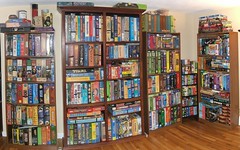
We said when we moved we'd make sure the new house had a room that could be the games room. Well, we moved, and we did (see photo) and I played a lot of games there. In the end I played 112 games at home, about 96 of them in the new house. Even better, the games room is front and center in the house, and I look forward to hosting more gaing sessions in 2009.
Gaming with Kids
My kids continue to turn in to excellent gamers. My 4-year-old is now playing games with meaningful choices and my 2-year-old's favorite way to delay bedtime is to ask "One more game?". Further, my 4-year-old was the person I played the most games with in 2008. In 2008, I played 63 games with her.
Gaming at Work
At the end of 2007 I started organizing gaming at lunch at work on Fridays. By mid-2008 we were regularly having two tables of gaming for the hour, and a waiting list for Race. We got a second copy of Race and expanded to Monday lunchtime gaming as well. In the end I played 59 games at lunch and another 29 at other work related events (retreats, after work, etc.) The majority of the work gaming has been Race, but with a solid sprinkling of Dominion, 6 nimmt!, For Sale, Pandemic, and the like.
Regular Gaming Group
I made 17 out of 24(?) sessions this year, and this remains my main source of variety in games and remains a great group to game with.
Overall Stats
- 370 Games Played
- 27% at home (family & guests)
- 24% at work
- 19% regular gaming group
- 18% "events" (eg, Unity Games)
- 12% other friends' homes
- 168 different Titles
- 140 days with at least one game played
- 66 new-to-me games played
- Gamed with 159 different people
- 26 new games or expansions acquired
- 80 games of Race for the Galaxy
- 22 games of Dominion
- 11 games of Electronic Catchphrase
- 8 games of Monkey Madness
- 8 games of Pandemic
- 6 games of 6 nimmt!
- 6 games of Arbos
- 5 games of Walk the Dogs
- 5 games of Go Away Monster!
- 5 games of Zack & Pack
Sunday, December 28, 2008
Lanna Thai Diner Review

This restaurant is an old 50's style diner; all chrome and vinyl, outside and in, but turned into a Thai restaurant. The owner, Max, is friendly and fun. The resulting ambiance is outstanding. Those things alone would make it worth visiting once, but what has made it our regular "date night", when we have grandparents around to do babysitting is the food.

All in all, I highly recommended Lanna Thai Diner (website, map, streetview)
Saturday, November 22, 2008
Atom feed of your recently played games
Scott and his team are a bit overworked so I wrote a simple scraper that turns your "games played" page on BGG into an Atom feed. If/when Scott gets around to officially supporting this, I'll make my feed generator redirect to the "real" one. (Atom is essentially the same as RSS and most services that support RSS support Atom)
Games Played Atom Feed Generator
For example, my games played.
I'm planning to also add feeds for plays of a particular game, or even a particular game by a particular person.
Games Played Atom Feed Generator
For example, my games played.
I'm planning to also add feeds for plays of a particular game, or even a particular game by a particular person.
Friday, November 21, 2008
In praise of short games
I like short games. I often find myself defending short games, and the preference for short games to other gamers, so I thought I'd write my thoughts down in a little detail.
First, definitions: A very short game is one that plays in 15 minutes or less. A short game is one that plays in 15-45 minutes. A medium game plays in 45-100 minutes. A long game plays in 100-180 minutes. A very long game plays in over 3 hours. That's how I use those words.
Part of my preference for short games comes from my opportunities to play. I don't get to game as much as I used to, and some of that limited time includes lunchtime gaming at work. But, my inclination toward short games extends back to before I had any such time constraints. The constraints have simply amplified the preference.
The standard argument is that longer games have more strategic opportunities, the ability to more thoroughly explore a game system, and overall to be "deeper". For the most part, I agree. The argument goes further something like, "If you're enjoying it, what's the difference between one two hour game and 4 half-hour games?". To me, a lot. This is the key, and why I prefer short games.
To get to the root of the issue requires deconstructing how I get enjoyment out of games. I enjoy the social aspect, it's part of why I don't do "online boardgaming" much if at all. I enjoy the decision making, but that's actually a small part. I enjoy the process: Going from a start condition where everyone is equal; adapting to random factors and other people's play; developing a strategy or strategies; picking tactics to execute that strategy; executing those tactics; resolving the endgame. The whole is far greater than the sum of the parts. The positive experience of a complete game, the beginning, middle and end, is greater than the micro-activity of "what do I do next". Each of those parts of the process has value in and of itself, not just "enjoyment per unit time". It's similar to why people presumably enjoy whole movies or TV shows rather than a simple collection of entertaining scenes. So, if the enjoyment of playing a good game yields 1 EP ("enjoyment point") per minute, I'd say the process of developing a strategy is worth 5-20 EP, on top of the time it takes. For each of the 5 or so "aspects" of gameplay, that often ends up being the dominant part of the fun. Plus, as mentioned, I like novelty/variety so I'd say most of the time I'd give a game a 1-10 EP bonus depending how long it's been since I'd played it.
Now, most very short games, and many short games have the problem that they don't have all that process in one game. They tend to be just tactical games (no strategy), or dominated by random factors, or insufficient variety to make the adaptation part meaningful, or trivial enough to make the execution automatic. But, say a good 30 minute game has obvious tactics given a strategy and a mundane endgame. This leaves it with 30 minutes of gametime, the adaptation aspect, the strategy development, and the execution. If each of these parts yields only 5 EP because, say they're more shallow than they might be in a longer game, then the game yields 45 EP, or 1.5EP/minute. Then, say I have a two hour game that has all 5 of the above aspects, but at a higher level of depth, so they're worth 10 EP each. This means that game is 170 EP, or 1.4EP/minute. So, I'd have gotten more EP playing 4 half hour games, even if I play the same one over 4 times. If I play different ones to get the "variety bonus", the gap widens. The specifics of this deconstruction aren't actually that important. It may be there's 10 aspects, not 5, etc. etc. The core is that there's something to "playing a complete game" which is more than just an activity.
Fortunately, there are some short and medium games that not only have all 5 (or whatever) of the above "aspects", but provide them with comparable quality to longer games. Race for the Galaxy is certainly one such game for me. It looks like Dominion may be too. But, on the flip side, longer games often suffer from a reverse problem; I used 1EP/minute as a baseline up there, but if the core activity of the game is more or less fun, that could be different. In a lot of longer games, I actually find the core activity is substantially less enjoyable. In some cases, this is why they're longer; they have 60 minutes of interesting stuff to do and 40 minutes of mundane manipulation or bookkeepping. This lowers their baseline rate and makes them less fun, for me. But, most shorter games don't quite hit enough of the aspects, while a 45-60 minute game usually does. So, in the end your 60 minute game which hits all 5 aspects at 5-10 points each, is just as good, or better, than the above-described hypothetical 30 minute game. This means I end up playing a lot of "medium" length games.
Finally, there's the issue of winning and losing. For the most part, my winning or losing doesn't have a huge effect on my enjoyment, but usually it is more fun to win than to lose, even if it's just a marginal effect. Other people's enjoyment also matters. In any game, one turn of bad luck, one error, or the confluence of small errors or luck can turn a game against someone. In a short game, it's over soon and the feeling of being stuck in a bad place resets. In a long game, you can get stuck there for a while. So, both because I would rather not be stuck with my errors or bad luck and because I don't want others' to feel stuck with errors or bad luck, it further pushes me away from long games.
But, there's an exception. There's a small number of very long games I like a lot. For example, Descent and Battlestations. These jump out of the above logic by being a lot of fun in the steady state, as an activity, unlike many long games, as well as usually having all the "aspects" in spades.
So, that's why I have a preference for short games, and obviously other poeple's structure/model for enjoying games may be radically different, but it's why I'll keep seeking out the Races of the world; short but complete and well-rounded games.
First, definitions: A very short game is one that plays in 15 minutes or less. A short game is one that plays in 15-45 minutes. A medium game plays in 45-100 minutes. A long game plays in 100-180 minutes. A very long game plays in over 3 hours. That's how I use those words.
Part of my preference for short games comes from my opportunities to play. I don't get to game as much as I used to, and some of that limited time includes lunchtime gaming at work. But, my inclination toward short games extends back to before I had any such time constraints. The constraints have simply amplified the preference.
The standard argument is that longer games have more strategic opportunities, the ability to more thoroughly explore a game system, and overall to be "deeper". For the most part, I agree. The argument goes further something like, "If you're enjoying it, what's the difference between one two hour game and 4 half-hour games?". To me, a lot. This is the key, and why I prefer short games.
To get to the root of the issue requires deconstructing how I get enjoyment out of games. I enjoy the social aspect, it's part of why I don't do "online boardgaming" much if at all. I enjoy the decision making, but that's actually a small part. I enjoy the process: Going from a start condition where everyone is equal; adapting to random factors and other people's play; developing a strategy or strategies; picking tactics to execute that strategy; executing those tactics; resolving the endgame. The whole is far greater than the sum of the parts. The positive experience of a complete game, the beginning, middle and end, is greater than the micro-activity of "what do I do next". Each of those parts of the process has value in and of itself, not just "enjoyment per unit time". It's similar to why people presumably enjoy whole movies or TV shows rather than a simple collection of entertaining scenes. So, if the enjoyment of playing a good game yields 1 EP ("enjoyment point") per minute, I'd say the process of developing a strategy is worth 5-20 EP, on top of the time it takes. For each of the 5 or so "aspects" of gameplay, that often ends up being the dominant part of the fun. Plus, as mentioned, I like novelty/variety so I'd say most of the time I'd give a game a 1-10 EP bonus depending how long it's been since I'd played it.
Now, most very short games, and many short games have the problem that they don't have all that process in one game. They tend to be just tactical games (no strategy), or dominated by random factors, or insufficient variety to make the adaptation part meaningful, or trivial enough to make the execution automatic. But, say a good 30 minute game has obvious tactics given a strategy and a mundane endgame. This leaves it with 30 minutes of gametime, the adaptation aspect, the strategy development, and the execution. If each of these parts yields only 5 EP because, say they're more shallow than they might be in a longer game, then the game yields 45 EP, or 1.5EP/minute. Then, say I have a two hour game that has all 5 of the above aspects, but at a higher level of depth, so they're worth 10 EP each. This means that game is 170 EP, or 1.4EP/minute. So, I'd have gotten more EP playing 4 half hour games, even if I play the same one over 4 times. If I play different ones to get the "variety bonus", the gap widens. The specifics of this deconstruction aren't actually that important. It may be there's 10 aspects, not 5, etc. etc. The core is that there's something to "playing a complete game" which is more than just an activity.
Fortunately, there are some short and medium games that not only have all 5 (or whatever) of the above "aspects", but provide them with comparable quality to longer games. Race for the Galaxy is certainly one such game for me. It looks like Dominion may be too. But, on the flip side, longer games often suffer from a reverse problem; I used 1EP/minute as a baseline up there, but if the core activity of the game is more or less fun, that could be different. In a lot of longer games, I actually find the core activity is substantially less enjoyable. In some cases, this is why they're longer; they have 60 minutes of interesting stuff to do and 40 minutes of mundane manipulation or bookkeepping. This lowers their baseline rate and makes them less fun, for me. But, most shorter games don't quite hit enough of the aspects, while a 45-60 minute game usually does. So, in the end your 60 minute game which hits all 5 aspects at 5-10 points each, is just as good, or better, than the above-described hypothetical 30 minute game. This means I end up playing a lot of "medium" length games.
Finally, there's the issue of winning and losing. For the most part, my winning or losing doesn't have a huge effect on my enjoyment, but usually it is more fun to win than to lose, even if it's just a marginal effect. Other people's enjoyment also matters. In any game, one turn of bad luck, one error, or the confluence of small errors or luck can turn a game against someone. In a short game, it's over soon and the feeling of being stuck in a bad place resets. In a long game, you can get stuck there for a while. So, both because I would rather not be stuck with my errors or bad luck and because I don't want others' to feel stuck with errors or bad luck, it further pushes me away from long games.
But, there's an exception. There's a small number of very long games I like a lot. For example, Descent and Battlestations. These jump out of the above logic by being a lot of fun in the steady state, as an activity, unlike many long games, as well as usually having all the "aspects" in spades.
So, that's why I have a preference for short games, and obviously other poeple's structure/model for enjoying games may be radically different, but it's why I'll keep seeking out the Races of the world; short but complete and well-rounded games.
Sunday, November 16, 2008
1000 different games
I love variety in games; I don't like playing the same game a lot. It's not unheard of for someone to suggest a game and have my reaction be "Oh, I just played that a few weeks ago.", or for games that are less favored, "Enh, I've already played that this year." The most favorite and filler-y of the fillers rarely receive more than 10 or 20 plays in a year, and for a while, I was playing a lot of games each year (~800). Recently, Race for the Galaxy, has been the exception, but the general rule still holds.
So, it was with pleasure and a certain degree of pride that I recently passed the 1000 different games played mark. Of course, I haven't been keeping track of games played my whole life, but I probably played a total of 15-50 different games before I have any chance of remembering details. Further, before 2000, I didn't keep very precise records. For example, I know I've played Wiz-War, but not since 2000, and I don't remember exactly when. So, the 1000 threshold is a little fuzzy, but I can now say I've played:
Some stats on the 1001 games:
So, it was with pleasure and a certain degree of pride that I recently passed the 1000 different games played mark. Of course, I haven't been keeping track of games played my whole life, but I probably played a total of 15-50 different games before I have any chance of remembering details. Further, before 2000, I didn't keep very precise records. For example, I know I've played Wiz-War, but not since 2000, and I don't remember exactly when. So, the 1000 threshold is a little fuzzy, but I can now say I've played:
- > 1030 different games in my life
- 1018 different games that I have some record of
- 1001 different games since 2000, for which I have specific logs
Some stats on the 1001 games:
- I own 52% of them.
- The average (mean) number of plays is 4.
- The median number of plays is 2.
- 47% have been played once.
- 22% have been played 5 or more times.
- 9% have been played 10 or more times.
- 1% have been played 38 or more times.
- I play at least one new game in 42% of gaming sessions.
- The average number of new games per session is 0.9
- Unsuprisingly, the rate at which I play new-to-me games has been almost monotonically decreasing over time, looking at a window of 100 new games. There was a brief upward blip the year when I first attended Gathering, when I played 54 new games in under a month, leading to 100 new games in 6 months. Lately, it takes me over a year to play 100 new games.
- Since 2000, there have only ever been 4 calendar months where I haven't played a new game. (August 2004, May & September 2005, Jun 2007)
- I've never played more than 10 new-to-me games on a single day, but I have played 10 on four separate occasions.
- I've played multiple games which begin with each letter of the alphabet, except X. I should clearly correct this, since I own at least 3.
- I still want to play more new games.
Sunday, November 2, 2008
Simple election Monte Carlo toy
I wanted to be able to fiddle with my own model of the electoral college. At the moment, despite the general media's efforts, the race isn't that close, but I wanted a modeling framework in which I could interpret "dramatic" changes that might occur.
So, I made a Personalized Election Modeler which lets you specify the chances you think Obama will win each state, and runs the simulation for you.
So, I made a Personalized Election Modeler which lets you specify the chances you think Obama will win each state, and runs the simulation for you.
Saturday, November 1, 2008
Request for online photo hosting/sharing suggestions and opinions
I'm looking for a good online photo sharing/backup solution. The three options I'm considering at the moment are SmugMug, Flickr and Picasaweb. None seem to be quite up to my requirements, so I'm hoping someone can suggest something better or how to use one of these services better. I'm leaning toward SmugMug, but I'm not entirely happy with it.
I want:
Thoughts, experiences, suggestions, ideas?
Update: I think I'm going to go with flickr. Easy browsing by time, good price, and it's fast.
I want:
- Reasonably priced for a large amount of storage. I have over 40G of photos and don't want to pay >$100 a year. This seems to eliminate Picasaweb.
- Access control. I actually like SmugMug's access model, but would prefer finer grained (per photo control) rather than having to move photos around between albums to change access. The three tiers of public/unlisted/password-protected work well for me.
- Automatic/easy upload from iPhoto, iPhone and Android. Most seem to do fine in this regard, but opinions are welcome.
- Decent file management. I want to be able to search browse and share all my photos at once, not have to go fiddle in dozens or hundreds of albums. I don't want to have to keep track of what I've uploaded and what I haven't. I don't want it to end up with bunch of duplicate uploads. All of them, including SmugMug seem to have issues here.
- Reliable. I'm want this in substantial part as a backup solution.
- Good temporal organization/photo finding. I think of my photos as organized by time, not by "album" and none of the sites seem to do well with this model.
Thoughts, experiences, suggestions, ideas?
Update: I think I'm going to go with flickr. Easy browsing by time, good price, and it's fast.
Sunday, October 19, 2008
Played a bunch of new games
The rate at which I play new games has been relatively steadily declining by 10-20% per year, until this year, when it looked like it might fall by by over 50%. As of last week, I had only played 29 new-to-me games this year (down from 73 in 2007, and a lot more in preceding years). But, yesterday I got to play a bunch (7) of new-to-me games, and I played two others earlier this week and that's worthy of a capsule reviews post. Because these are all based on one or two plays, they're probably, if anything, slightly over-inflated since I tend to like new things.
Tribune. [BGG] This obviously has a lot of positive buzz and it's fairly well deserved. It seems to have captured the positive qualities of a lot of role-selection/worker-placement games while playing in a reasonable time. The multiple parallel paths to victory quality is very nice. A-
Dreizehnte Holzwurm. [BGG] I got this as a "sweetener" in a trade over 5 years ago and only just got around to playing it. That's a real shame since it's a cute game of tactical cardplay and brinkmanship. The comparison to 6 nimmt! is a fair, but tenuous one. A nice filler. B
Handelsfursten. [BGG] A sort of generic Knizia filler card game. The game actually feels like it ends a little quickly for the number of potential opportunities for choices. In the end, it just didn't leave much of an impression, but makes a good filler. B
Container. [BGG] This is clearly a really neat economic game. It's also as try as the theme (container ships) would suggest. The system of A produces, B buys and resells to C who then auctions it to D, where A!=B, B!=C and C!=D is a little hard to wrap your head around, especially since the auction payouts are matched by the bank and the fact that your most common good type is thrown out. A little too much arbitrariness and dryness in an otherwise strong package. If I felt at all engaged, the rating would go up a lot. B-
Neue Heimant. [BGG] A cute little little auction game, but not one I enjoyed because the game has multiple sever "cliffs" in the final scoring. By that I mean an small change in where something gets built at the end of the game has a radical impact on scores. I like that kind of chaos/subtlety in the incremental mechanisms of games, but in the final scoring it's just sort of annoying. C
Witch's Brew. [BGG] A cute little role selection game with a nice cardplay twist. Unfortunately, it doesn't quite live up to its potential, in that the cardplay ends up feeling a bit too uncontrolled. But, maybe that's just inexperience. I should try this one a few more times before I make a real judgement. B+
Jamaica. [BGG] Wow. The art on this (same artist as Animalia) is beautiful and remarkably functional as well. It's definitely a "family game" but it's clever and quick. The multiple resources required to run the race and the ebb and flow of the cards makes for a nice experience. This was the biggest hit out of this crop of games. A
Cannonball Colony. [BGG] Cute little tactical conflict game. I wasn't going to call it a "wargme", but I guess it simply is. For the right person, this is probably a great game. For me, not so much. Too much pure direct conflict and the geometric and tactical nature was just not sufficiently engaging. C
Shadow Hunters. [BGG] A nice fun hidden alliances game. Some players are Hunters, some are Shadows, and some are Neutral, but you don't know who, so you go around attacking each other and gathering information. I think I agree with Felix's comment that it's better than Bang!, but scratches the same itch. Plus, it plays in much less time than it claims (30 minutes, not an hour). Not a lot of depth, but it's fun and that's the point of this sort of game. B+
Tribune. [BGG] This obviously has a lot of positive buzz and it's fairly well deserved. It seems to have captured the positive qualities of a lot of role-selection/worker-placement games while playing in a reasonable time. The multiple parallel paths to victory quality is very nice. A-
Dreizehnte Holzwurm. [BGG] I got this as a "sweetener" in a trade over 5 years ago and only just got around to playing it. That's a real shame since it's a cute game of tactical cardplay and brinkmanship. The comparison to 6 nimmt! is a fair, but tenuous one. A nice filler. B
Handelsfursten. [BGG] A sort of generic Knizia filler card game. The game actually feels like it ends a little quickly for the number of potential opportunities for choices. In the end, it just didn't leave much of an impression, but makes a good filler. B
Container. [BGG] This is clearly a really neat economic game. It's also as try as the theme (container ships) would suggest. The system of A produces, B buys and resells to C who then auctions it to D, where A!=B, B!=C and C!=D is a little hard to wrap your head around, especially since the auction payouts are matched by the bank and the fact that your most common good type is thrown out. A little too much arbitrariness and dryness in an otherwise strong package. If I felt at all engaged, the rating would go up a lot. B-
Neue Heimant. [BGG] A cute little little auction game, but not one I enjoyed because the game has multiple sever "cliffs" in the final scoring. By that I mean an small change in where something gets built at the end of the game has a radical impact on scores. I like that kind of chaos/subtlety in the incremental mechanisms of games, but in the final scoring it's just sort of annoying. C
Witch's Brew. [BGG] A cute little role selection game with a nice cardplay twist. Unfortunately, it doesn't quite live up to its potential, in that the cardplay ends up feeling a bit too uncontrolled. But, maybe that's just inexperience. I should try this one a few more times before I make a real judgement. B+
Jamaica. [BGG] Wow. The art on this (same artist as Animalia) is beautiful and remarkably functional as well. It's definitely a "family game" but it's clever and quick. The multiple resources required to run the race and the ebb and flow of the cards makes for a nice experience. This was the biggest hit out of this crop of games. A
Cannonball Colony. [BGG] Cute little tactical conflict game. I wasn't going to call it a "wargme", but I guess it simply is. For the right person, this is probably a great game. For me, not so much. Too much pure direct conflict and the geometric and tactical nature was just not sufficiently engaging. C
Shadow Hunters. [BGG] A nice fun hidden alliances game. Some players are Hunters, some are Shadows, and some are Neutral, but you don't know who, so you go around attacking each other and gathering information. I think I agree with Felix's comment that it's better than Bang!, but scratches the same itch. Plus, it plays in much less time than it claims (30 minutes, not an hour). Not a lot of depth, but it's fun and that's the point of this sort of game. B+
Thursday, October 16, 2008
BaordGameGeek and AppEngine
AppEngine is fun. I've been fiddling on a number of personal projects using it lately, some involving BoardGameGeek. A month ago, I posted there, but forgot to post here: I made a fun BGG collection comparison tool. The combination of the BGG XML API and AppEngine with urlfetch (and ElementTree) makes writing BGG "add-ons" pretty easy. I'll certainly keep writing more, but other people should write some too. Don't know python? Well, it's a nice language and worth learning. :)
And, to get you started, here's the (sloppy, not cleaned up, but functional) bggcoll.py library for fetching collection info from BGG. It lets you do things like:
coll = bggcoll.GetCollection(username)
while doing all the nice things like stuffing it in memcache, the datastore, and only refetching it from BGG if the local copy is stale.
And, to get you started, here's the (sloppy, not cleaned up, but functional) bggcoll.py library for fetching collection info from BGG. It lets you do things like:
coll = bggcoll.GetCollection(username)
while doing all the nice things like stuffing it in memcache, the datastore, and only refetching it from BGG if the local copy is stale.
Subscribe to:
Posts (Atom)